What Can You Do After 12th? 15 Best Career Options for Students in 2026
By: Admin |
13 Auguest , 2025

🎓 CAREER GUIDE • 2026
What Can You Do After 12th? 15 Best Career Options for Students in 2026
Completing Class 12 is an exciting milestone, but it can also bring one
of the biggest questions in a student's life:
"What should I do after 12th?"
With hundreds of courses, colleges, career paths, professional programs,
and emerging opportunities available today, choosing the right direction
can sometimes feel confusing. The good news is that students have more
career options than ever before.
Whether you are interested in technology, creativity, business, design,
hospitality, media, science, or entrepreneurship, there is a career path
that can match your interests and strengths.
In this guide, we explore
15 career options after 12th, the skills they require,
possible courses, career opportunities, and why choosing the right
education can make a difference to your future.
🧭 Quick Career Explorer
Start by thinking about what you naturally enjoy. Your interests, strengths,
personality, and long-term goals can help you identify a suitable career
direction.
💻
Love Technology?
Explore IT, software development, AI, data, and digital careers.
🎨
Love Creativity?
Consider fashion, graphic design, interior design, media, and
creative careers.
🚀
Want to Build Something?
Explore management, entrepreneurship, business, and startup
opportunities.
🎯 Why Choosing the Right Career After 12th Matters
Your decision after Class 12 can influence the subjects you study, the
skills you develop, the internships you pursue, and the opportunities you
explore during your college years.
However, choosing a career does not mean you have to predict your entire
future at the age of 17 or 18. Career development is a journey. The goal is
to choose a direction that matches your current interests and then continue
learning and adapting as you gain experience.
💡
Remember This
Don't choose a course only because it is popular. Consider your
interests, strengths, career goals, learning preferences, and the
practical opportunities offered by the program.
01
💻
TECHNOLOGY
Information Technology
Information Technology is an attractive career choice for students who
enjoy computers, technology, programming, websites, applications, and
digital systems.
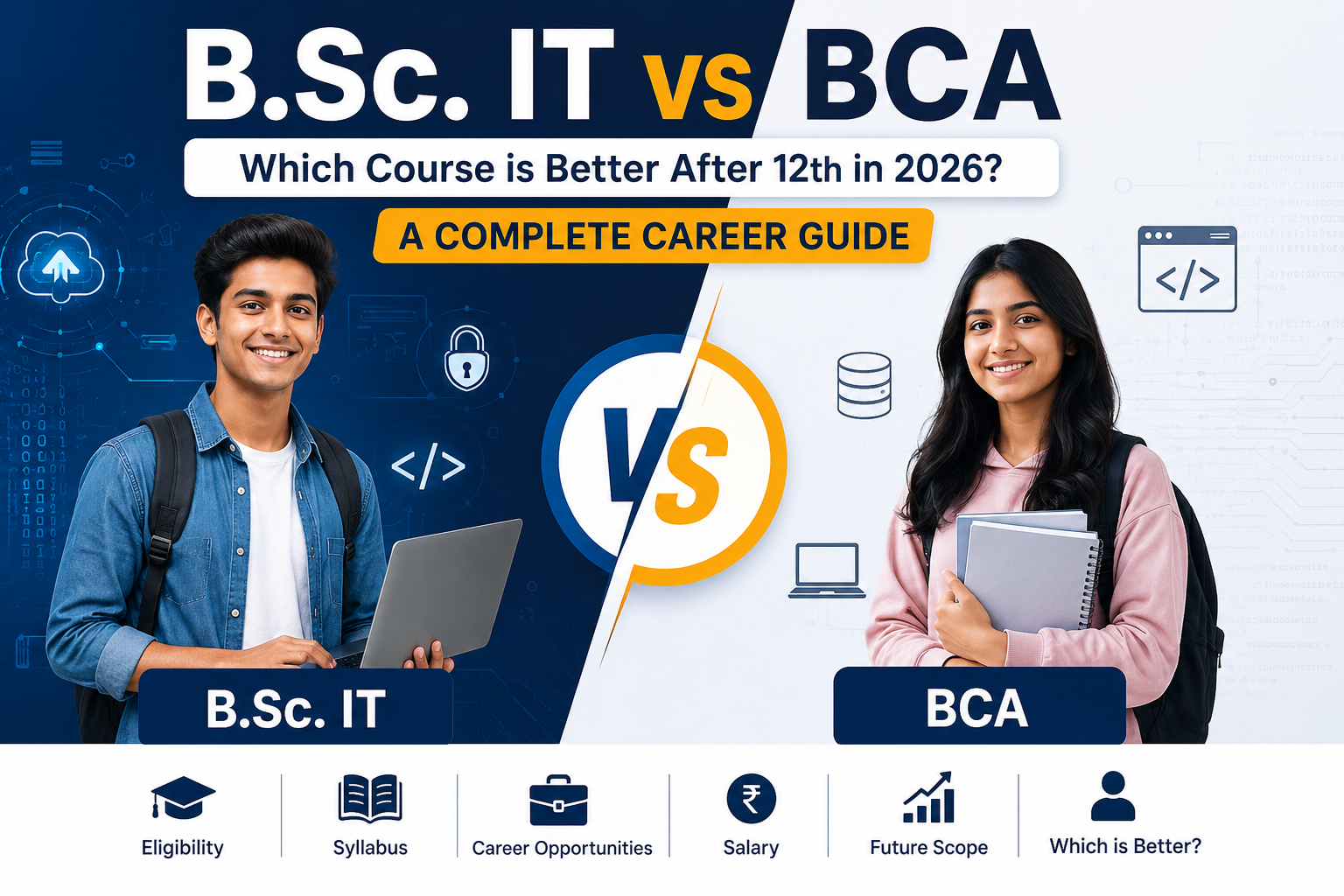
Students can explore undergraduate programs such as B.Sc. IT, BCA, and
other computer-related degrees depending on their eligibility and career
interests.
💡 Suitable For
Students interested in computers and technology.
🛠️ Skills
Programming, problem solving, logical thinking, digital skills.
💼 Careers
Software Developer, Web Developer, IT Professional, Application Developer.
02
👗
CREATIVE CAREER
Fashion Designing
Fashion designing is ideal for students who enjoy colours, fabrics,
clothing, styling, illustration, creativity, and visual expression.
A professional fashion design program can introduce students to fashion
illustration, textile knowledge, pattern making, garment construction,
styling, CAD, merchandising, and fashion marketing.
🎨 Suitable For
Creative students interested in fashion and design.
🛠️ Skills
Creativity, illustration, textile knowledge, styling.
💼 Careers
Fashion Designer, Stylist, Textile Designer, Merchandiser.
03
🎨
DESIGN
Graphic Designing
Graphic design combines creativity and technology to communicate ideas
through visual content.
Students interested in branding, social media graphics, typography,
advertising, illustrations, websites, and visual communication can
consider graphic design as a career direction.
🎯 Suitable For
Students who enjoy visual creativity.
💻 Skills
Design software, typography, colour theory, creativity.
💼 Careers
Graphic Designer, Visual Designer, Brand Designer, Creative Professional.
04
🏠
DESIGN
Interior Designing
Interior design can be an exciting option for students who enjoy
architecture, spaces, colours, furniture, materials, and creative
planning.
Students learn to develop concepts and transform spaces into functional
and visually appealing environments.
🏠 Suitable For
Students interested in spaces and creative planning.
📐 Skills
Drawing, design software, space planning, creativity.
💼 Careers
Interior Designer, Space Planner, Design Consultant, Visualiser.
05
🏨
HOSPITALITY
Hotel & Hospitality Management
Hospitality management is suitable for students who enjoy interacting
with people, travel, customer service, food, events, and professional
environments.
Career opportunities can exist across hotels, restaurants, resorts,
cruise companies, airlines, event organisations, and other hospitality
businesses.
🤝 Suitable For
Students who enjoy people and service-oriented careers.
🛠️ Skills
Communication, teamwork, customer service, organisation.
💼 Careers
Hotel Professional, Event Professional, Food Service Professional, Hospitality Manager.
06
📊
BUSINESS
Business & Management
Business and management programs can help students understand
organisations, marketing, finance, human resources, operations, and
entrepreneurship.
Students who enjoy leadership, communication, planning, and decision
making may find management-related careers interesting.
07
📱
DIGITAL
Digital Marketing
Digital marketing has become an important part of modern business.
Students can explore careers involving social media, content marketing,
search engine optimisation, online advertising, email marketing, and
analytics.
This field can be particularly interesting for students who enjoy
communication, creativity, technology, and understanding consumer
behaviour.
08
🤖
EMERGING TECHNOLOGY
Artificial Intelligence & Emerging Technology
Artificial intelligence is influencing many industries, from technology
and business to design, education, marketing, and healthcare.
Students interested in mathematics, computers, programming, data, and
emerging technologies can explore AI-related educational pathways.
09
📈
DATA
Data & Analytics
Data is increasingly important for organisations making business and
operational decisions. Students interested in numbers, statistics,
computers, and analytical thinking can explore data-related careers.
Skills such as data analysis, statistics, visualisation, spreadsheets,
programming, and analytical thinking can be useful in this field.
10
🎬
MEDIA
Media & Content Creation
The growth of digital platforms has created opportunities for students
interested in video, photography, writing, social media, podcasting,
storytelling, and creative communication.
Students can develop skills in video editing, photography, writing,
graphic design, presentation, storytelling, and digital publishing.
11
🚀
ENTREPRENEURSHIP
Entrepreneurship
Students do not always have to follow a traditional employment path.
Entrepreneurship allows individuals to turn ideas into businesses,
products, services, or online ventures.
Students interested in business can develop skills in communication,
marketing, finance, leadership, customer research, and problem solving.
12
✈️
TRAVEL
Travel & Tourism
Travel and tourism can suit students interested in destinations,
hospitality, travel planning, customer interaction, culture, and event
experiences.
Career possibilities can include travel companies, tourism organisations,
hospitality businesses, event companies, and related service industries.
13
🏛️
PUBLIC SERVICE
Government & Competitive Examinations
Students interested in public service can explore government careers
through relevant competitive examinations after completing the required
educational qualifications.
Preparation generally requires discipline, subject knowledge, general
awareness, reasoning, communication, and consistent study habits,
depending on the examination.
14
🔬
SCIENCE
Science & Research
Students with strong interest in scientific subjects can explore
undergraduate programs and later specialise through higher education and
research.
Curiosity, analytical thinking, research skills, patience, and a strong
understanding of scientific concepts are valuable in this pathway.
15
🧑⚕️
HEALTHCARE
Healthcare & Allied Fields
Healthcare offers a wide range of educational and professional pathways.
Depending on their academic background and eligibility, students can
explore different healthcare and allied health programs.
These careers generally require dedication, professional training,
responsibility, communication, and a strong interest in helping people.
🔎 Which Career Could Be Right for You?
💻 I enjoy computers and technology
IT • AI • Data • Software
🎨 I love creativity and design
Fashion • Graphic • Interior Design
🤝 I enjoy meeting and helping people
Hospitality • Tourism • Management
📊 I like numbers and analysis
Data • Finance • Business
🎬 I enjoy media and storytelling
Content • Media • Digital Marketing
🚀 I want to start my own business
Entrepreneurship • Management
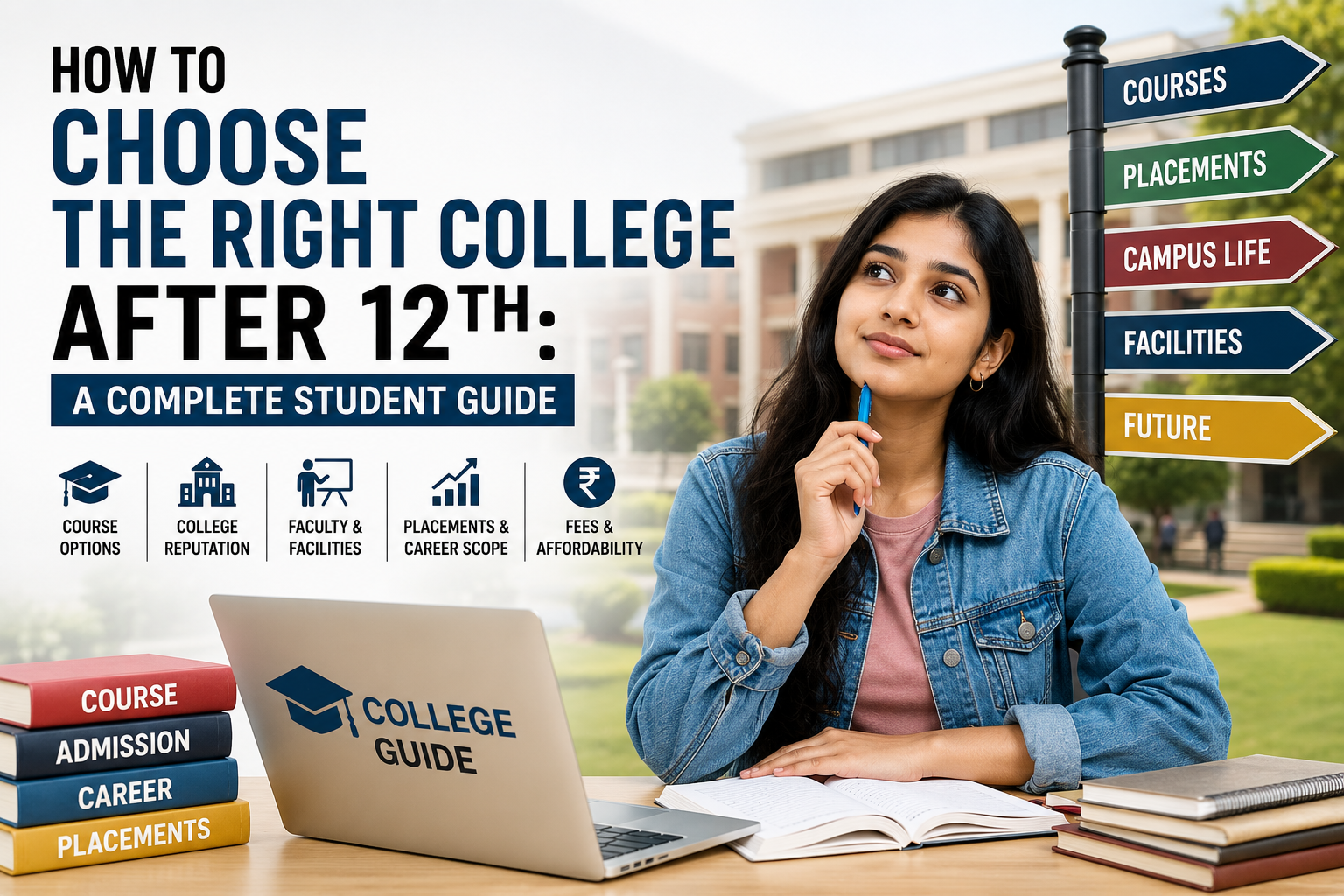
🧠 How to Choose the Right Career After 12th
Choosing a career should be a thoughtful process rather than a decision made
under pressure. Before selecting a course or college, consider the following
factors.
01
Know Your Interests
Think about the subjects, activities, and projects you genuinely enjoy.
02
Understand Your Strengths
Identify the skills and abilities that come naturally to you.
03
Research Career Opportunities
Explore what professionals actually do in the career you are considering.
04
Compare Courses
Check curriculum, practical learning, internships, projects, and other
opportunities.
05
Research the College
Consider faculty, infrastructure, learning environment, exposure,
location, and student support.
06
Think Long Term
Consider where the course can take you after graduation and what
higher-study options may be available.
✅ Before Choosing Your College, Ask These Questions
- Does the college provide practical learning?
- Does the curriculum match current industry requirements?
- Are students given opportunities for internships?
- Are there workshops and industry interactions?
- Does the college encourage projects and portfolio development?
- What kind of infrastructure and learning facilities are available?
- Does the institute provide career guidance and placement support?
- Will the college help me develop communication and professional skills?
🏫 CAREER-FOCUSED EDUCATION
Why Consider HIDT for Your Higher Education?
Choosing the right institution is an important part of your career
journey. At Himalayan Institute of Design & Technology
(HIDT), students can develop academic knowledge alongside
practical and professional skills.
The learning environment focuses on helping students understand concepts,
apply their knowledge, participate in projects, develop portfolios, and
prepare for the professional world.
🎓
Career-Focused Courses
Programs designed around academic and professional development.
💻
Practical Learning
Opportunities to apply concepts through projects and activities.
🚀
Career Preparation
Focus on skills that can support students in their professional journey.
🗺️ Your Journey From 12th to Career
1
Complete 12th
Understand your interests and strengths.
↓
2
Explore Careers
Research courses and professional pathways.
↓
3
Choose Your Course
Select a program that matches your goals.
↓
4
Build Skills
Develop technical and professional abilities.
↓
5
Gain Experience
Complete projects, internships, and practical activities.
↓
6
Build Your Career
Enter employment, pursue higher education, or start a venture.
🎓
Your Career Journey Starts With One Good Decision
There is no single "best" career after 12th. The best career is one that
matches your interests, abilities, goals, and willingness to keep learning.
Take time to explore your options, compare courses, research colleges,
develop practical skills, and make a decision based on your own strengths
rather than simply following trends.
🚀 Explore. Learn. Practise. Grow.
❓ Frequently Asked Questions About Careers After 12th
What are the best career options after 12th?
There is no single best career for everyone. Students can explore
technology, design, business, hospitality, media, healthcare,
science, entrepreneurship, and many other fields depending on their
interests and eligibility.
How should I choose a career after 12th?
Consider your interests, strengths, subjects you enjoy, career goals,
course curriculum, practical learning opportunities, and future
career possibilities before making your decision.
Which courses are good for creative students?
Creative students can explore areas such as fashion designing,
graphic designing, interior designing, media, content creation,
visual communication, and other design-oriented programs.
Which career options are suitable for students interested in computers?
Students interested in computers can explore Information Technology,
software development, data, artificial intelligence, web development,
applications, and other technology-related fields.
Is a degree enough to build a successful career?
A degree provides academic knowledge, but students can strengthen
their career preparation by developing practical skills, completing
projects, gaining experience, building portfolios, and improving
communication skills.
Why are internships important for students?
Internships can expose students to professional environments and
help them understand how their academic knowledge is applied in
real-world situations.
Should I choose a popular course or a course I enjoy?
Popularity should not be the only factor. Students should consider
their interests, strengths, career goals, course structure, learning
opportunities, and future plans.
What skills should students develop during college?
Students can develop communication, teamwork, problem solving,
digital skills, creativity, time management, presentation abilities,
technical skills, and practical industry knowledge.
Can students start a business after graduation?
Yes. Students interested in entrepreneurship can explore startups,
online businesses, freelancing, consulting, creative businesses,
boutiques, agencies, and other ventures depending on their skills
and interests.
How important is practical learning?
Practical learning helps students apply academic concepts through
projects, assignments, workshops, internships, and real-world
activities, helping them develop greater confidence and professional
readiness.
What should I check before selecting a college?
Students should consider the course curriculum, faculty, practical
learning, infrastructure, industry exposure, internships, student
activities, career guidance, placement support, and overall learning
environment.
Why is choosing the right college important?
The right educational environment can provide students with academic
knowledge, practical exposure, professional skills, networking
opportunities, and guidance during their college journey.
🎯
Still Confused About Your Career?
Start by understanding your interests, exploring different career paths,
and choosing an educational program that helps you develop both knowledge
and practical skills.
Your journey after 12th doesn't have to be perfect from day one.
What matters is taking the first step in the right direction.



_21Oct24_114818.jpg)